Jayme Sean Rosenthal
Originating Executive Producer
Private art adviser and dealer whose practice in modern and contemporary masters dates to 1988. Rosenthal originated the documentary project and serves as its originating executive producer.
A film about vision, timing & artistic legacy
Artists Change Everything.
CASTELLI tells the story of Leo Castelli, the defining art dealer of the late twentieth century, whose extraordinary eye, elegance, and instinct for bridging downtown creativity with uptown patronage transformed radical new voices into international cultural icons and helped shape the contemporary art world as we know it.
Through intimate conversations and rare archival footage with the artists, dealers, collectors, curators, family, and friends who inhabited his world, the film brings to life the man, the moment, and the vision that changed how contemporary art was discovered, championed, and valued.
And others who worked with, collected, exhibited, and lived alongside Leo Castelli during the decisive decades in which contemporary art assumed its present form.
Artists Change Everything.
Artists Change Everything.
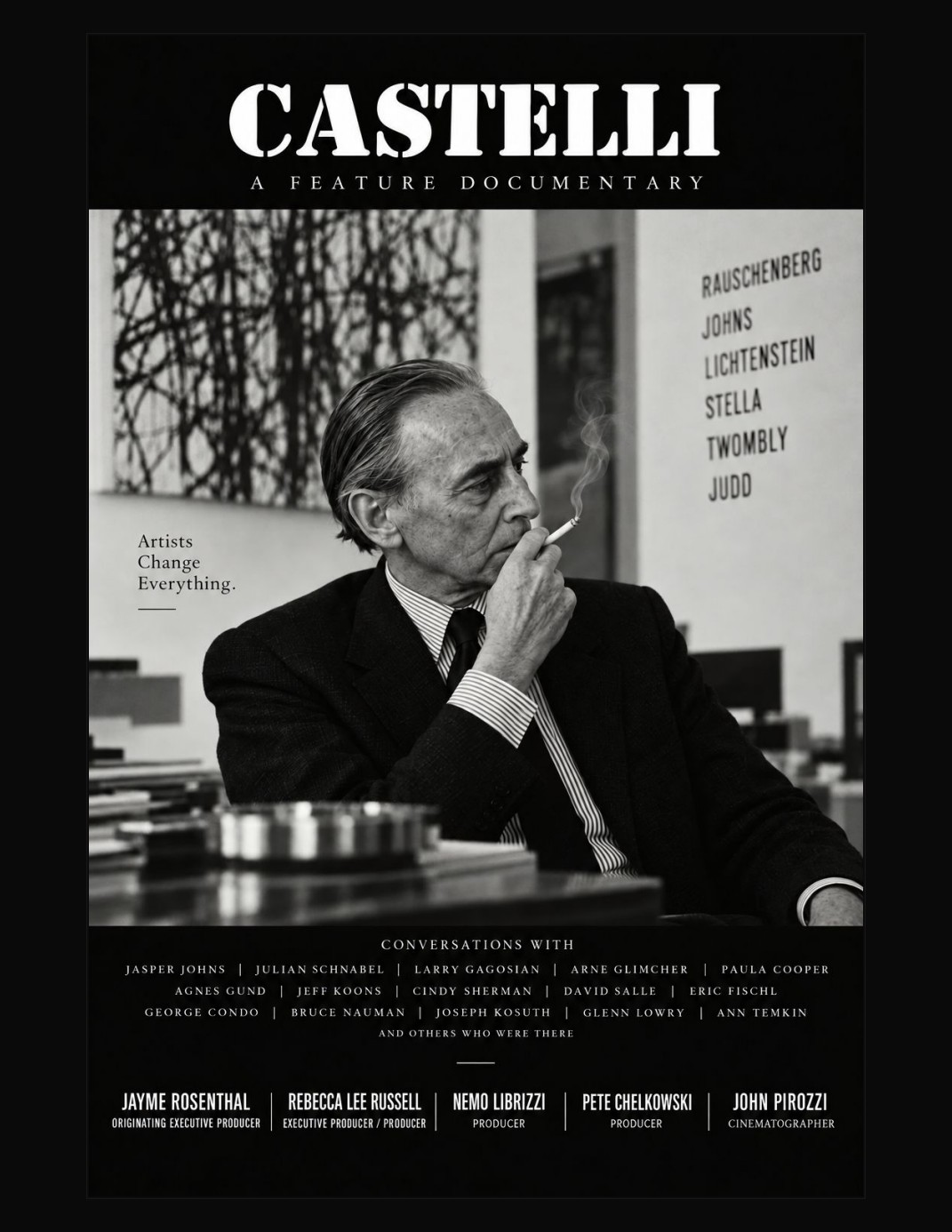
Runtime, production year, aspect ratio, delivery format, and poster/image dimensions were not included in the current materials and remain to be confirmed.
Leo Castelli’s importance lies not only in the artists he championed, but in the way he helped a new art find its audience. Opening his New York gallery in 1957, he brought artists such as Jasper Johns and Robert Rauschenberg into sustained view, then continued to present work that challenged familiar definitions of painting, sculpture, and authorship.
Castelli made the gallery a place where artists, collectors, critics, and institutions could meet around work that was not yet fully understood. His gift was a particular kind of attention: recognizing the force of an unfamiliar idea, standing behind it, and allowing time for others to see what he saw. The film follows that exchange between individual vision and a changing public—a story of advocacy, relationships, and the cultural life that can gather around art.
Originating Executive Producer
Private art adviser and dealer whose practice in modern and contemporary masters dates to 1988. Rosenthal originated the documentary project and serves as its originating executive producer.
Producer
Recognized the film within the conversations and memories shared with Jayme, and helps advance its creative and producing direction.
Leo Castelli opened his gallery in New York in 1957 and rapidly became the central figure in the elevation of postwar American art. His early and sustained representation of Jasper Johns and Robert Rauschenberg marked a decisive turn.
He subsequently brought forward Frank Stella, Roy Lichtenstein, Andy Warhol, Cy Twombly, Donald Judd, Bruce Nauman, Joseph Kosuth, and many others who would define the major movements of the late twentieth century. Castelli’s gallery system, international network, and ability to bind artists, collectors, and institutions helped contemporary art achieve global cultural and market authority.
The film records the precise historical interval in which radical artistic production was translated into enduring cultural reality — an act of vision, timing, and sustained commitment that continues to structure the contemporary art world.
CASTELLI tells the story of Leo Castelli, the defining art dealer of the late twentieth century, whose extraordinary eye, elegance, and instinct for bridging downtown creativity with uptown patronage transformed radical new voices into international cultural icons and helped shape the contemporary art world as we know it.
The film is being developed around intimate conversations with people who inhabited that world, supported by archival research: artists, dealers, collectors, curators, family, and friends. Its central concern is the relationship between a singular individual and the cultural transformation he helped make possible.
Originating Executive Producer Jayme Sean Rosenthal brings his personal memories of Leo and a practice in modern and contemporary art dating to 1988. Those recollections provide a point of entry into the man behind the gallery: how he looked, listened, encouraged artists, and built relationships. The intended approach places personal testimony in conversation with independently researched historical evidence.
From his European origins to the creative ferment of postwar New York, the proposed narrative follows Castelli across intersecting worlds: artistic experiment, exile and reinvention, collecting, museums, and the formation of an international market. The film asks how trust and conviction helped unfamiliar work acquire cultural meaning, and how those relationships changed as the market expanded.
The visual approach will combine filmed testimony, artwork and exhibition histories, correspondence, photographs, and moving-image archives, subject to access and rights clearance. Interviews and archival sequences are planned development elements; specific participation and licenses will be established individually.
Jayme Sean Rosenthal — Originating Executive Producer
Rebecca Lee Russell — Producer
Nemo Librizzi — Producer
Pete Chelkowski — Producer
John Pirozzi — Cinematographer
Rebecca Lee Russell has been central to the project’s development, recognizing the film within the conversations and memories shared with Jayme and helping advance its creative and producing direction.
Story and research: develop the treatment, interview plan, historical chronology, and scholarly advisory relationships.
Filmed material: record initial testimony and create a focused sample demonstrating the film’s tone and narrative approach.
Archives and rights: identify source materials, assess access, and obtain licensing estimates.
Production planning: prepare the detailed budget, schedule, financing plan, and appropriate fiscal-sponsorship application.
We welcome conversations with documentary funders, cultural patrons, prospective co-producers, archives, scholars, and institutions. Development support would be directed toward the defined work above. Scope, budget, deliverables, and any recognition would be agreed in writing before a commitment.
The project is in development. Funding, fiscal sponsorship, distribution, archive permissions, and interview participation are being pursued and are not represented as secured. Any philanthropic support would follow the requirements of an approved fiscal sponsor; any investment proposal would be documented separately. Editorial decisions remain with the filmmaking team.
And others who were there. The film draws on the direct testimony of those who worked with, collected, exhibited, and lived alongside Leo Castelli during the decisive decades in which contemporary art assumed its present form.
In 1961 Roy Lichtenstein brought a group of new paintings to Leo Castelli’s gallery, then a townhouse at 4 East 77th Street. He expected to go on teaching and painting, and could think of one gallery where pictures like these might find a place. Ivan Karp showed them to Leo. Some appealed to him at once; others left him, as he recalled years later, “very puzzled and interested.”
Castelli remembered hanging one where Robert Rauschenberg would see it, and Rauschenberg coming back after a night to think. The two men revisit the encounter in a conversation with Barbaralee Diamonstein-Spielvogel for Inside New York’s Art World, a program Duke University’s archive dates to 1977. When Castelli wonders aloud whether his own taste shaped Lichtenstein’s, the painter answers with a joke about going home to paint funny pictures. The artist gets the last word on the theory about him.
One of the first paintings leaves a paper trail. In November 1961 Castelli bought Girl with Ball from Lichtenstein. By May 1962 it belonged to Philip Johnson, who gave it to the Museum of Modern Art in 1981.
A sequence in development for CASTELLI. Archive permissions are being sought and are not represented as secured.
This document is issued for professional distribution in connection with the feature documentary CASTELLI. All rights reserved. For screening, partnership, or further information, contact the originating office.
Originating Executive Producer · Jayme Sean Rosenthal